




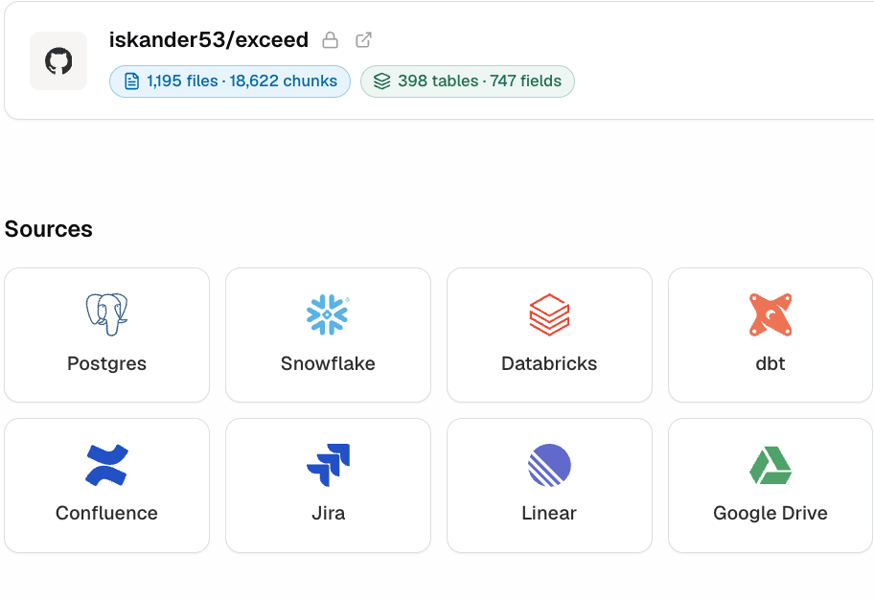
Auto-documentation
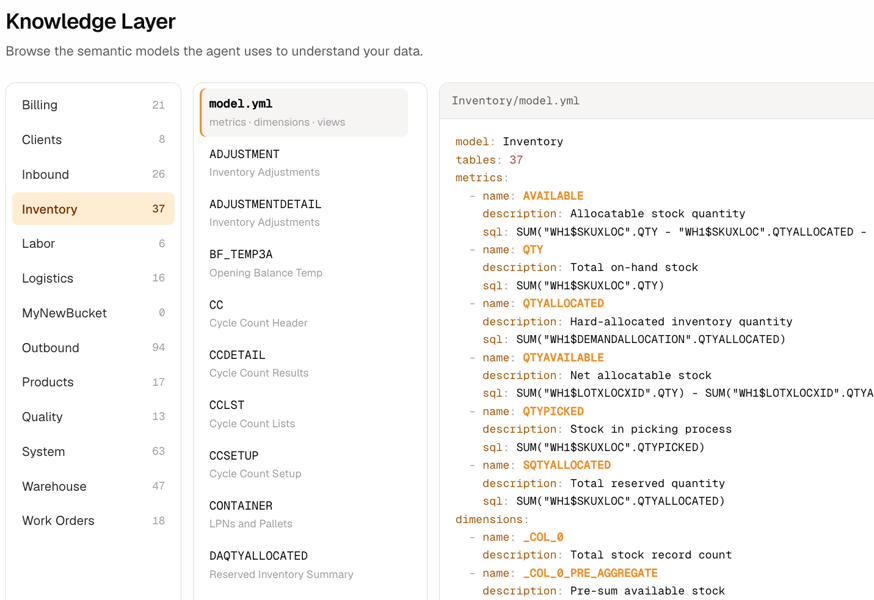
Reads your warehouse schema, git history and existing docs, and describes every table, column and synonym in the company.

Shanc is a self-updating context data layer for AI. It builds a live layer from git history and query logs, and updates it on every commit. Data you can finally trust, with no layer to build or maintain.
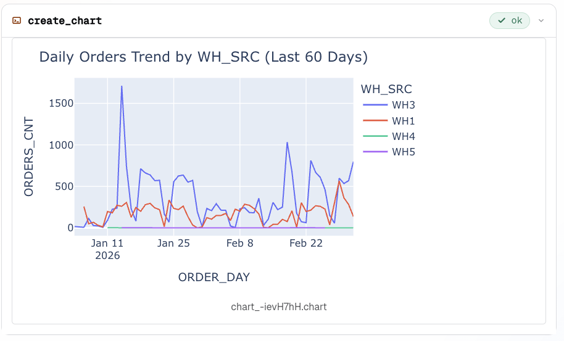
which channels bring users who actually stick around?
"stick around" → your team measures retention as week-4 active (dbt/models/fct_user_activity.sql). channel and LTV live in dim_users, joined on user_id. pulling the cohorts.
paid social brings the most users, lowest week-4 retention (18%). organic and referral are half the volume at roughly double — 41% and 44%. referral also hits payback ~3 weeks sooner.
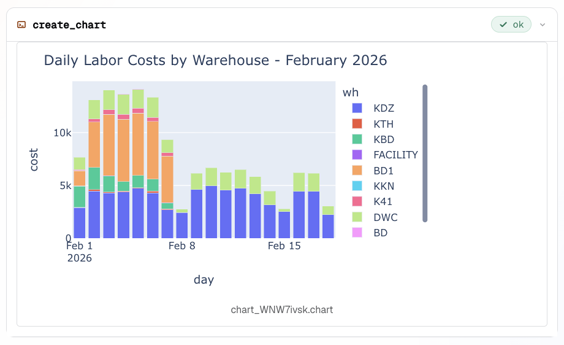
heads up: in your query logs "referral" bundles two things — invite links and partner deals. split them?
yes
partner deals carry it — 52% week-4, vs 34% for invite links. invite links behave like paid social.
save this to the layer? marked unverified until you approve.
Analysts lose 15% of their time updating the layer. And it still runs behind the warehouse.
Shanc builds and maintains the layer, so there's no context to paste at the start of each session and no line-by-line review of the output.
People paste in schemas from memory at the start of each session. It works okay for whoever did it, but none of it reaches anyone else.
Shanc turns that context into one shared layer, so your data AI works across the whole team instead of one person at a time.
Build the layer yourself and it's an engineer's salary to keep current. Run an agent without one and you pay to reload your schema into context on every query.
Without a layer, an agent reloads your whole schema and definitions on every query — you pay for those tokens every time. Shanc loads the context once, so each question uses far fewer.
Analysts lose 15 hours a week explaining data to an agent and checking what comes back — capacity heads of analytics are trying to free before they hire.
Shanc makes your data available and precise, so exploration and product iterations move faster.
Half of data teams say a typical request takes 1–4 weeks. Leaders and teams waste 25% of their time just searching for answers.
Shanc is grounded in your data and code — structured, organised and precise. Your business partners get answers they can trust, and you're not left worrying they've acted on wrong numbers.
An ungrounded agent answers analytical questions correctly 10–30% of the time. A senior analyst catches the bad ones; a middle one or a marketing manager doesn't, and acts on them.
Running the same questions through Shanc — validated against a maintained layer of real definitions — roughly doubles that. Faster and more accurate at once, which is the trade every other AI analytics setup makes you choose between.
Reads your warehouse schema, git history and existing docs, and describes every table, column and synonym in the company.
Built from your query logs. CAC, LTV, net profit, conversion — defined the way your team calculates them. Includes which filters to apply and how the tables join.
Without a layer, an agent reloads your schema and definitions into context on every question. Shanc holds that context once, so each query carries only what it needs.
Every commit and schema change is picked up automatically. No manual maintenance, no drift between the layer and the warehouse.
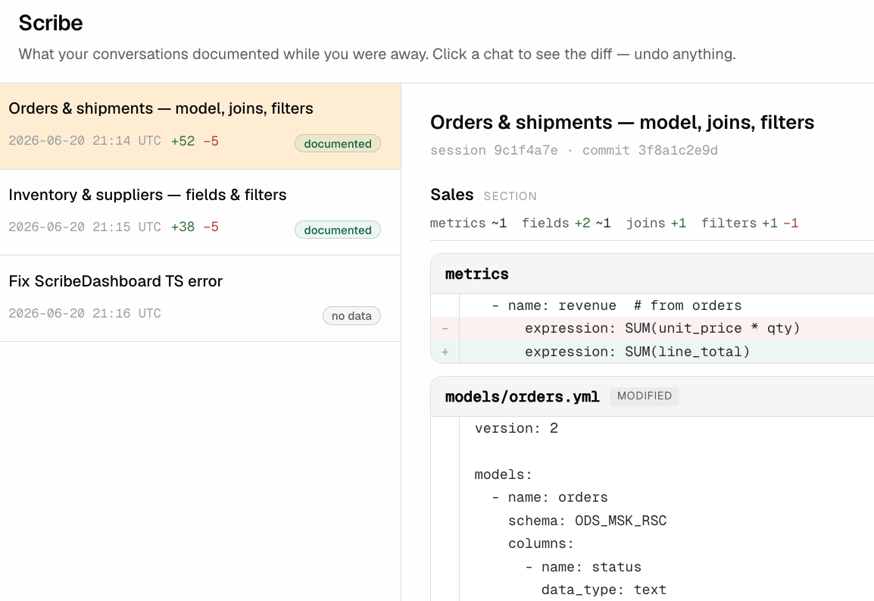
Exploration sessions are written back into the layer. Findings are marked unverified until you approve them, and the agent is told which is which.
Shanc runs as an MCP server. Connect Claude, Codex or anything that speaks the protocol. Your warehouse, dbt and BI tools stay as they are. There's a Shanc interface if you'd rather query there.
Your own LLM account, billed at your rate. The layer is prebuilt, so agents stop re-loading schema and lineage on every session. You control token spend.
Start free on your own machine. Connect your team when you're ready. The layer and the workflow are the same at every step — the only thing that changes is how much of the company it covers.
For one analyst or business user.
Up to 10 people, up to 50 tables.
Up to 50 people, up to 500 tables.
50+ people, 500+ tables.
| Signal source | Method | |
|---|---|---|
| Method #1 | Data source | Schema extraction and fields profiling |
| Method #2 | Query logs and dashboards | Data usage extraction and statistical analysis |
| Method #3 | Source repos | Data structure and lineage mining |
| Method #4 | Docs / wikis | Business entities and knowledge mapping |
| Method #5 | Chats with agents | Auto-correction loop |
 Runs in your environment
Shanc runs on your own machine or inside your cloud, alongside the warehouse it reads. Compute against your data happens where the data already lives — never on infrastructure Shanc operates, and never through a Shanc-hosted service.
Compliance & data protectionSOC 2 Type I in progress. Read-only, least-privilege access to your warehouse — Shanc never requests write scope.
On-premise deploymentFor teams whose data can't touch a cloud: Shanc installs entirely within your own datacentre, including air-gapped environments. No outbound connection, no dependency on any Shanc-hosted service.
Saved per analyst each month.
Fewer tokens than an agent loading context from scratch each session.
More accurate than an agent querying your warehouse directly.
Choose your level:
Someone defined "active user" last quarter; someone else is about to define it again, differently. The knowledge is spread across a team and a stack, and keeping it consistent is a job nobody owns. Shanc holds one layer everyone's work resolves against.
You have a semantic layer, a metrics glossary, a catalog — and someone updates it by hand every time a developer ships a schema change. Shanc rebuilds it automatically, so "current" stops being someone's responsibility.
You pointed an agent at your warehouse, it worked until the schema moved, and now you're re-explaining your data every session or watching it drift. Shanc is the layer that stays current so you don't do that again.
You're early enough that the definitions still live in a few heads — and you know that won't hold as you grow. Every quarter adds tables, people, one more version of "revenue." Shanc lays the layer down now and keeps it current as you scale, so your context grows with the company instead of becoming something you have to untangle later.
Serves consistent definitions across a large, multi-source warehouse feeding several markets.
Documents a complex legacy operational schema so agents answer without an engineer in the loop.
Feeds validated context to its own agents, so answers about product data stay grounded.
Lets business teams self-serve on sales and inventory data against trusted definitions.
Standardises client and utilisation metrics across projects into one queryable layer.
Aligns booking, occupancy and revenue metrics across listings, so operations and finance read the same numbers.
Grounds analyst queries in verified metric definitions, so transaction and revenue numbers reconcile across teams.
Gives its data team one shared glossary for engagement and retention metrics across a fast-changing product.
A bare LLM, agentic tools, or building the layer by hand — and where Shanc lands.
You can, but Claude doesn't know what your data means. It doesn't know that rev_net is the revenue Finance uses, which table is canonical, or how two tables are meant to join. So it guesses, and a wrong answer is worse than no answer. The missing piece is context — what every table and metric actually means. Shanc builds that and keeps it current, so Claude reasons over facts instead of guessing.
You can build a context layer — plenty of teams do. Building it isn't the hard part; keeping it alive is. The layer is accurate the day you finish it and starts drifting the next time a developer ships a schema change. Maintaining it by hand becomes a standing job: someone tracks every commit, updates definitions, re-checks joins. That's the cost Shanc removes. It reads your git history and query logs and updates the layer on its own, so you get what you'd build yourself, without the person whose whole job is keeping it from going stale.
An LLM is only as good as the context it's given, and on its own it has none of yours. Ask it about your data and it fills the gaps with plausible guesses — the more fluent it sounds, the easier those guesses are to miss. More prompting doesn't fix it; it produces more confident wrong answers. Shanc gives the model a factual layer to reason over, so it works from your real definitions instead of inventing them. Same model, roughly twice the accuracy on analytical tasks.
A skill is a set of instructions you write for an agent. It's static, it isn't grounded in your actual schema, and it goes out of date the moment your data changes — so the agent follows the instruction confidently and still returns the wrong number. Shanc isn't instructions about your data, it's a structured layer built from your data: real tables, real definitions, real query logs, validated before anything runs and updated as the data moves.
Most tools here either replace your stack or still need a person to maintain them. BI platforms ask you to move your analytics into their interface. Warehouse-native layers get curated by hand. The ones that auto-generate a layer mostly build it once and leave you to keep it current. Shanc sits under the stack you already have, maintains the layer itself from your commits and query logs, and serves it to whatever agent you already use over MCP. Nothing to migrate, nobody assigned to keep it alive.
Omni is a BI platform — you move your analytics into it, and its context layer is built and curated by your team inside its interface. Shanc is the layer underneath. It doesn't replace your BI tool or ask anyone to switch tools; it auto-maintains the definitions from your commits and query logs, then serves them to whatever AI you already use. Omni owns the interface; Shanc owns the context and plugs into yours.
A semantic layer is part of it — metric definitions, join paths, terminology. Shanc keeps that current automatically instead of by hand, and adds what a semantic layer alone doesn't: query-log patterns, the corrections analysts make while exploring, and validation before a query runs. The difference that matters to your buyer is maintenance — a semantic layer is something you keep up to date; Shanc keeps itself up to date.
Context layers aren't new. Context layers that maintain themselves are. Normally the definitions are hand-written and go stale on the next schema change. Shanc reads your git history and query logs and updates the layer automatically, so it reflects your data as it is today, not as it was six months ago. And what your analysts work out while exploring gets written back in, so the layer sharpens with use instead of decaying.
Data and analytics teams that want their AI to answer reliably, and the analysts, PMs and business people asking the questions. The ones who feel the pain first are usually data engineers — the people who'd otherwise keep documentation alive by hand — and heads of data who want one trusted set of definitions across the company.
Everything resolves against one shared layer, so dashboards, reports and AI all use the same definitions and "revenue" means the same thing everywhere. Before a query runs, Shanc validates the SQL against that layer, so answers stay grounded and safe to act on. What analysts discover in exploration stays marked unverified until you approve it, so nothing is silently promoted to fact.
Warehouses: Snowflake, Databricks, Redshift and BigQuery. Agents: anything that speaks MCP — Claude, Codex and others. Shanc reads from your git (GitHub or GitLab), your query logs and your docs, and doesn't ask you to change any of them.
No. Shanc runs locally on your machine, and no data leaves your environment. Connecting your full stack unlocks continuous sync, team-level layers and multiplayer mode when you're ready. In connected mode, only structural metadata and aggregate statistics leave — schemas, column types, query patterns — never row-level data.
SOC 2 Type I in progress, expected Q4 2026. Type II to follow. Shanc holds read-only access to your warehouse, never requests write scope, and can run entirely locally with no egress at all.
No. Shanc sits alongside your stack and reads from it — git history, warehouse query logs, your knowledge base, any docs you point it at. You keep everything you already use; Shanc gives your AI the context it's missing.
Your sources: git history, data warehouse query logs and any documentation you want included. Connect them and you have a working layer in minutes.
Run it free locally to see it on your own machine, or book a demo to connect your full data stack.